On this page
A few minutes of regular care prevents most breakdowns, and the best garage door maintenance tips cost you nothing but time. For Perth homeowners, simple seasonal upkeep — lubricating the moving parts, checking the balance and testing the safety sensors — keeps a heavy door quiet, safe and reliable, and helps it survive our hot summers and coastal salt air. This checklist walks you through exactly what to do, how often, and the few jobs best left to a licensed technician.
Why does garage door maintenance matter?
Your garage door is the largest and heaviest moving object in most homes — often 80 to 100 kg cycling up and down thousands of times a year. Consistent garage door upkeep does three things: it keeps the door safe (a balanced door and working sensors protect kids, pets and cars), it stops small problems becoming expensive ones (a dry roller becomes a seized roller becomes a bent track), and it extends the life of the springs, cables and opener. Skip it and you usually pay for it later in a sudden, badly-timed failure.
Perth's climate makes upkeep more important than in many cities. Homes in coastal suburbs — from Scarborough and Hillarys to Fremantle and Mandurah — cop salt-laden air that accelerates rust on springs, fasteners and tracks, while UV and summer heat dry out lubricant faster. If you live within a few kilometres of the ocean, inspect and re-lubricate more often than the standard schedule below.
How often should you do garage door maintenance?
There's no single rule, but a practical garage door maintenance schedule for most Perth homes looks like the list below. Adjust upward if your door is used heavily (multiple cycles a day) or sits close to the coast.
- Monthly: watch and listen to a full open/close cycle for grinding, scraping or jerking — your earliest warning sign.
- Every 1–3 months: lubricate the rollers, hinges, springs, bearings and opener rail, and wipe down the tracks.
- Every 3–6 months: run the balance test, test the auto-reverse safety features, and tighten visible bolts and brackets.
- Coastal homes: bump rust checks and lubrication up to monthly.
- Annually: book a professional service and safety inspection.
Your DIY garage door maintenance checklist
Most of the routine is well within a confident homeowner's reach — no special tools beyond a spanner, a cloth and the right spray. Work through this garage door maintenance checklist each season, and keep your hands well clear of any part under tension.
Routine garage door maintenance checklist
- Visually inspect the springs, cables, rollers, pulleys and tracks for rust, fraying, gaps or wear — look, don't touch the tensioned parts.
- Listen to a full cycle and note any new grinding, popping or scraping.
- Clean the tracks with a damp cloth — they should be clean, not greased.
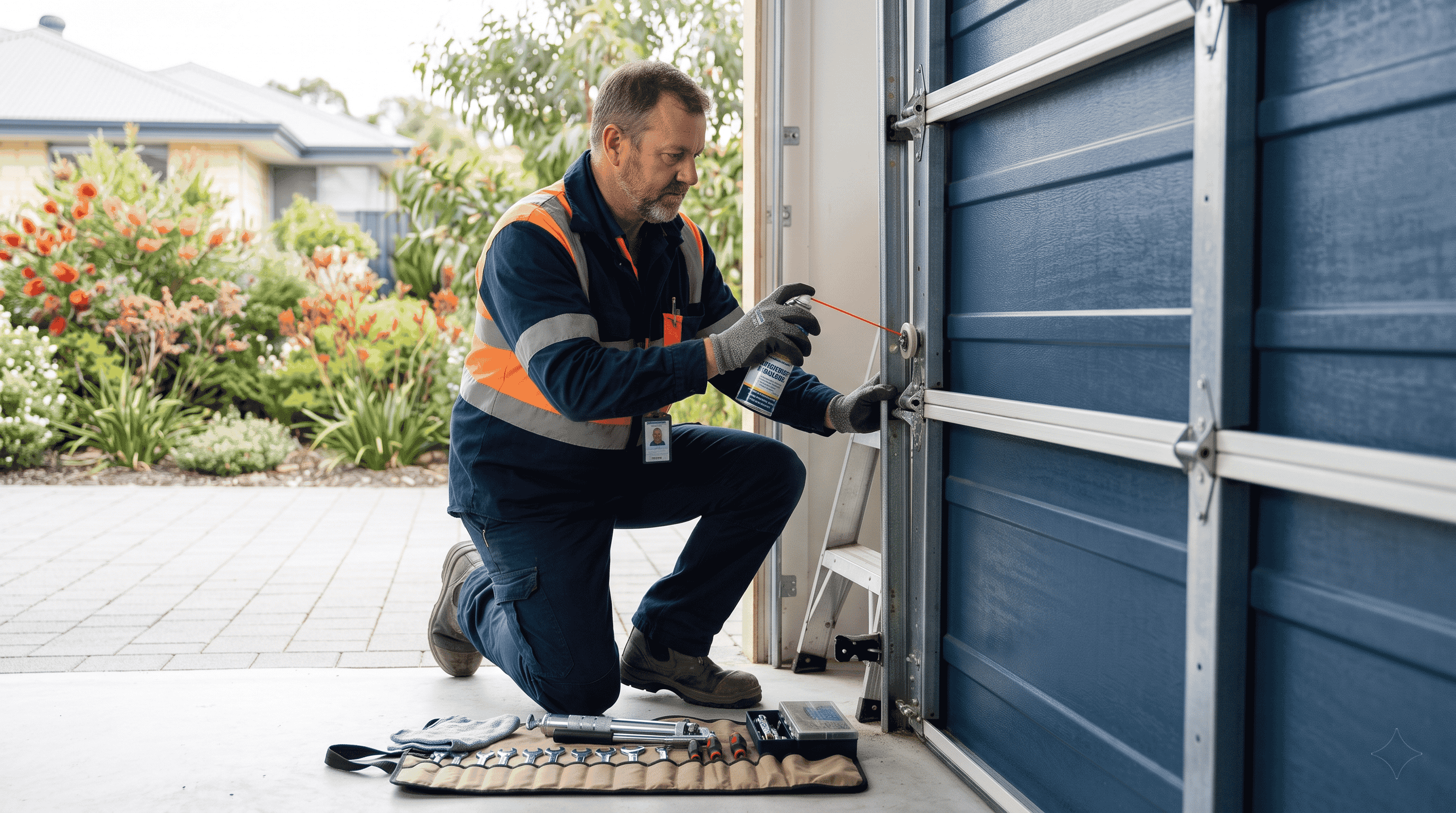
- Lubricate the rollers, hinges, springs, bearing plates and opener rail with a garage-door-specific spray.
- Tighten loose bolts, nuts and bracket fasteners with a spanner (hand-tight — don't over-torque).
- Check the bottom and side weather seals for cracks or gaps that let in water, dust and pests.
- Run the balance test (see below).
- Test the auto-reverse safety sensors and pressure reverse.
- Wipe down the door panels — important for Colorbond doors in salt-air suburbs.
What lubricant should you use (and avoid)?
Lubrication is the single highest-value job on the list. Use a product made for garage doors — a lithium- or silicone-based spray — applied lightly to the moving metal parts, then wipe away the excess so it doesn't collect grit.
- Do use a garage-door lithium or silicone spray lubricant.
- Do apply it to the rollers, hinges, springs, bearing plates and the opener's chain or screw rail.
- Do wipe off the excess so it doesn't attract Perth dust.
- Don't use WD-40 as a lubricant — it's a degreaser and penetrant that strips existing grease.
- Don't grease the inside of the tracks — rollers should roll, not slide; tracks only need to be clean.
- Don't use heavy grease that collects dust and forms a grinding paste.
How do you test the balance and safety sensors?
Two quick tests tell you whether your door is healthy, and together they take under five minutes. Do them with the door fully clear and nothing parked underneath.
- Close the door and pull the opener's manual release cord (usually a red handle).
- Lift the door by hand to about waist height and let go.
- A balanced door stays put. If it slams down or springs upward, the spring tension is off — book a technician.
- Re-engage the opener by pulling the cord back or running a normal cycle.
- With the opener connected, start closing the door.
- Wave a broom or box through the photo-eye beam near the floor.
- The door should stop and reverse immediately. If it doesn't, clean the sensor lenses, check their alignment, and stop using the door until it works.
Never DIY the springs or cables
Torsion and extension springs and the lifting cables are under extreme tension — enough to cause serious injury if they let go. Don't try to adjust, wind or replace them, and don't remove the bottom roller brackets where the cables anchor. If a spring is broken, a cable is frayed, or the door won't balance, stop and call a licensed garage door technician.
What should you leave to a professional?
- Torsion or extension spring adjustment or replacement.
- Lifting cable repair or replacement.
- Bent, misaligned or damaged tracks.
- Opener motor faults, force/limit adjustments and circuit-board issues.
- A door that's off-balance, sagging or out of square.
- Any repair that needs the door held under tension.
How much does it cost to service a garage door in Perth?
Wondering how much to service a garage door? A standard professional service in Perth — a full inspection, lubrication, balance and safety testing, plus minor adjustments — typically costs around $120 to $250, depending on the door's type, size and how much tuning it needs. That garage door maintenance cost is modest insurance against a spring or cable failure, which can run several hundred dollars and tends to happen at the worst possible time.
- Door type and size — single vs double, sectional vs roller vs tilt.
- Travel to outer or coastal suburbs.
- Whether it's a service only or includes minor parts such as rollers or seals.
- Add-on safety upgrades or opener tuning.
Treat these figures as a guide rather than a quote — a quick look at your door lets a technician price it accurately.
Keep your Perth garage door running smoothly
Stick to this checklist and most doors will run quietly for years. If the balance test fails, you spot rust on the springs or cables, or the door simply feels rough, it's worth a professional set of eyes. Capital Garage Doors services and repairs doors right across Perth — get in touch for a maintenance service or a no-obligation quote.
The cheapest repair is the one you prevent — ten minutes of lubrication and a balance test beats a weekend breakdown every time.