On this page
"Have you tried turning it off and on again" genuinely applies to garage doors. Openers are simple computers, and a surprising share of the 'broken motor' calls we attend end with a reset — of the remote, the motor's memory, or the travel limits. Here's how to do each one, in the order worth trying, and the signs that tell you it's a genuine fault instead.
Step 1: Reset the remote
- Open the remote and take the battery out for 30 seconds, then re-fit it (check it's a fresh battery while you're there — a weak cell causes more 'faults' than everything else combined).
- Re-program the remote to the motor: press the learn/SET/CODE button on the powerhead, then press the remote button within the 10–30 second window. Our remote programming guide covers the brand-specific quirks.
- Test from the driveway, not just under the motor — range problems masquerade as pairing problems.
Step 2: Clear the opener's memory
Every opener stores its paired remotes in memory, and that memory can fill up or corrupt. Clearing it is also the right move after a remote is lost or stolen — until you do, the missing remote still opens your door.
- Press and HOLD the learn button on the powerhead — typically about 10 seconds — until its LED goes out or flashes rapidly.
- That's it: every remote, keypad and (on some models) phone pairing is now erased.
- Re-program each remote you want to keep, one at a time.
Lost or stolen remote?
Clear the memory the same day. A garage remote that went missing with anything carrying your address is a key to your house. Two minutes on a ladder closes that door — literally.
Step 3: Reset after a power outage
After Perth's summer storms this is our most common call. Most modern openers re-find their position automatically: run one full open-close cycle from the wall button and watch it complete. If the door was disengaged onto manual release during the blackout, re-engage it first — pull the release cord toward the door (or run the opener until the trolley clicks back in) — then cycle it.
If the door now stops short of the floor, reverses at the last moment, or leaves a gap at the top, its travel limits have drifted. Limits are set on the powerhead — dials on older units, buttons with LED indicators on newer ones — and one notch of adjustment is often all it takes. The label inside the light cover usually shows the procedure for your model.
When a reset won't fix it
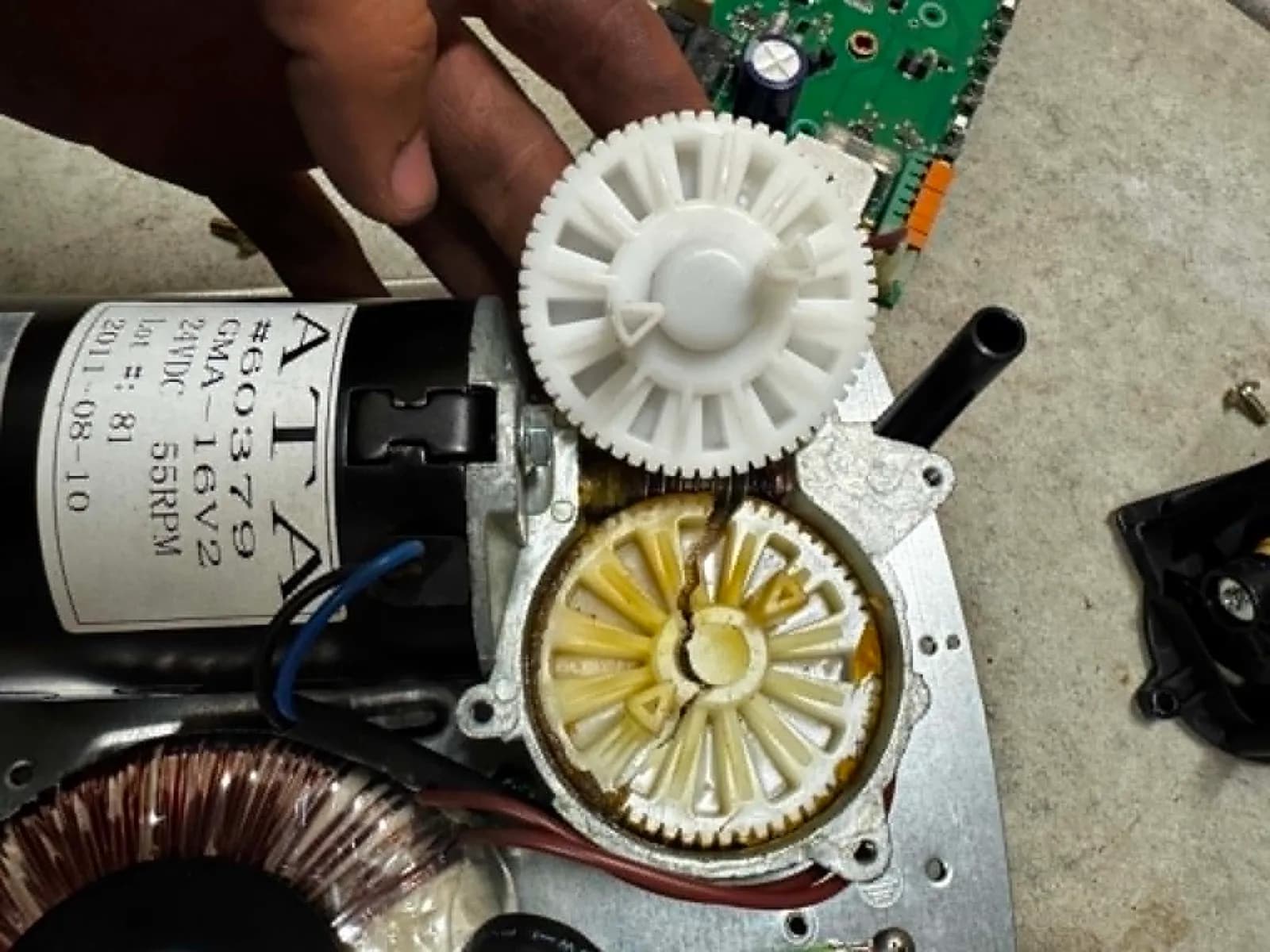
- **The motor hums but the door doesn't move** — stripped drive gear or a snapped belt/chain, a mechanical repair.
- **The door is suddenly very heavy on manual release** — a broken spring. Stop using the opener entirely; forcing it burns out motors. This one is an urgent repair.
- **Remotes keep un-pairing after a proper clear and re-program** — failing receiver or logic board.
- **The door reverses at random points** — safety sensors misaligned or failing (see our sensor guide), or the force limits are masking a binding door.
- **Clicking relay, dead display, burning smell** — logic board on the way out. Unplug it and call.
Opener repairs in Perth typically run $380–$490 for receiver, gear and board-level faults, and a full motor replacement is $770–$990 supplied, installed and programmed. If your opener is over 15 years old and misbehaving weekly, replacement is usually the honest recommendation — you get soft start/stop, better safety reversing and Wi-Fi control in the deal.