On this page
If your garage door suddenly becomes impossible to lift, or it bangs shut and refuses to stay open, the spring is almost always the culprit. There are two main types of garage door springs — torsion and extension — and nearly every door in Perth relies on one of them to carry the weight. Understanding how each system works, and which one you have, helps you catch problems early and talk confidently with a technician before a small fault turns into a stuck door on a Monday morning.
Do all garage doors have springs?
Almost all of them do. The springs counterbalance the door so the opener — or you, lifting by hand — only has to manage a few kilograms instead of the full 50–100kg of a panelled door. Without springs, a motor would burn out within months and lifting the door manually would be a genuine two-person job. The main exceptions are some very light single tilt doors and a handful of counterweight systems, but for residential sectional and roller doors across Perth, a spring is doing the heavy lifting every time the door moves.
How do garage door springs work?
How do garage door springs work? They run on a simple principle: counterbalance. When the door is fully closed the springs are under maximum load and store energy. As the door lifts, that stored energy is released to offset the door's weight, so the panel feels almost weightless through its whole travel and holds position wherever you stop it. The two designs store and release that energy differently — torsion springs twist, extension springs stretch — but the goal is identical: keep the door balanced at every point so the opener isn't fighting gravity.
- Counterbalance the door's weight so it opens and closes smoothly.
- Take the strain off the opener motor, extending its life.
- Let the door be opened safely by hand during a power cut.
- Hold the door in any partly open position without drifting.
Torsion springs: how they work and where they're used
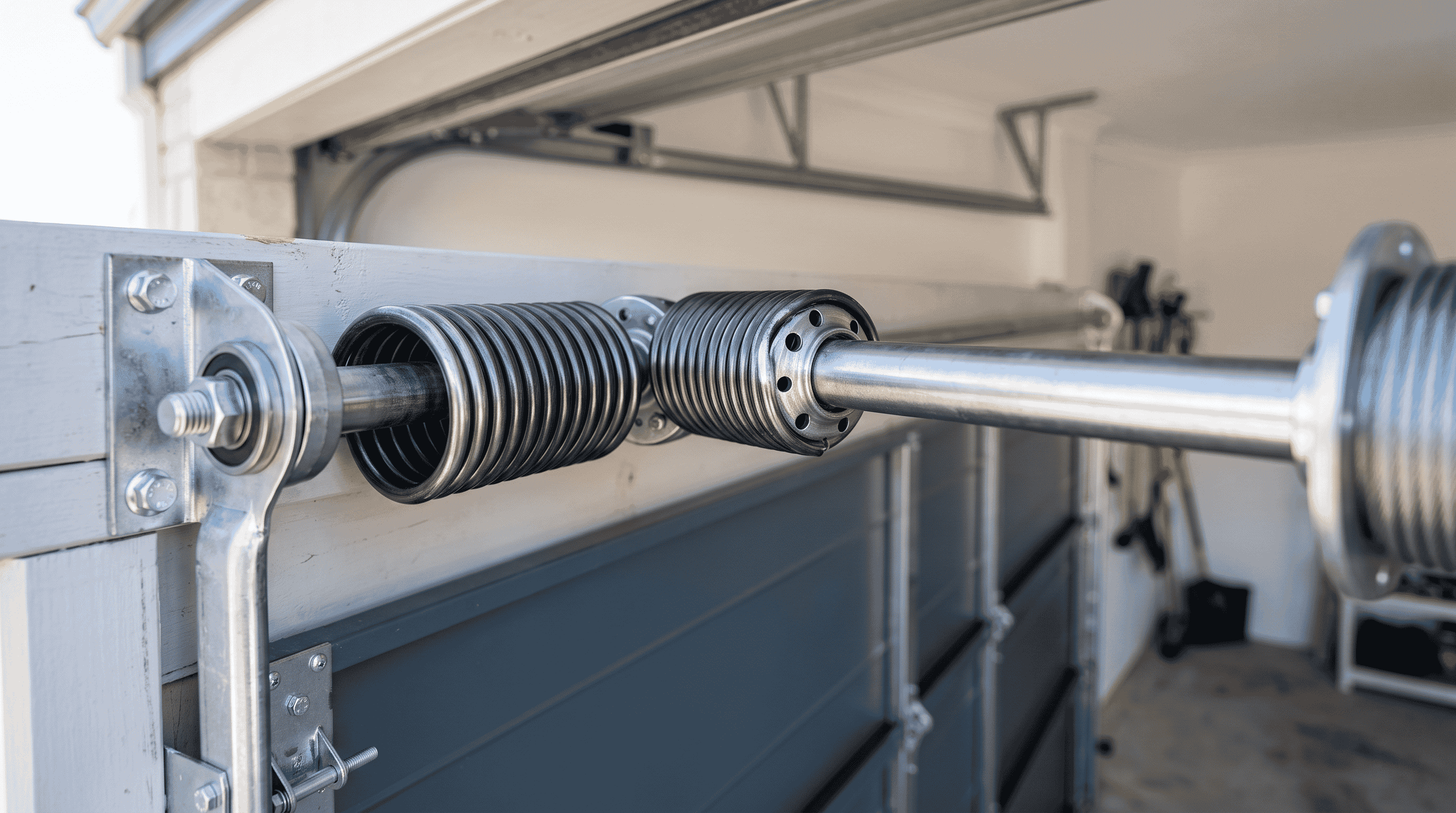
Torsion springs sit on a steel shaft mounted horizontally above the door opening. When the door closes, cables wound around drums at each end of the shaft force the spring to wind up and store energy; when the door opens, the spring unwinds and turns the shaft to lift the door. Because they twist rather than stretch, torsion springs deliver a controlled, balanced lift and handle heavier doors comfortably. They are the standard on modern sectional doors and most mid-to-large Perth garages.
- Mounted above the door on a central shaft — easy to spot from inside the garage.
- Smoother, quieter and better balanced than extension springs.
- Cope well with heavy, insulated or double-width doors.
- Torsion spring lifespan is typically 10,000–15,000 cycles for a standard spring, with high-cycle versions rated to 20,000 or more (one full open-and-close equals one cycle).
Extension springs: how they work and where they're used
Extension springs run along the horizontal tracks above each side of the door and stretch lengthways as the door closes, then contract to help lift it. They work in a left-and-right pair, each carrying half the load. Extension springs are cheaper and simpler, so you'll often find them on older homes, lighter single doors and some tilt doors around Perth. Their main drawback is that when one fails it can fly across the garage, which is why every safe extension setup must include a containment safety cable threaded through the spring.
- Mounted along the side tracks rather than above the door.
- Lower upfront cost and simpler to fit on light doors.
- Must always run with a safety cable to contain a broken spring.
- Tend to wear less evenly and feel jerkier than torsion springs on heavier doors.
Never adjust or replace a tensioned spring yourself
Both torsion and extension springs hold enormous stored energy even when the door is closed. A spring or winding bar that slips can cause serious hand, eye and head injuries. Adjusting, winding or replacing springs is a job for a trained technician with the correct winding bars and clamps — if a spring is broken or the door feels heavy, leave it down and call a professional.
Torsion vs extension springs: which is better?
In the torsion vs extension springs debate, torsion almost always wins on performance and longevity, while extension wins on upfront cost. For most Perth homeowners replacing a worn system, torsion is the better long-term choice — especially on heavier or double doors — because it lasts longer, runs quieter and is gentler on the opener. Extension springs still make sense on lighter doors or where the existing track layout is built for them.
- Durability: torsion typically lasts longer per cycle than extension.
- Balance and noise: torsion is smoother and quieter; extension can feel jerky.
- Safety: torsion stays on its shaft if it breaks; extension needs a safety cable to be safe.
- Cost: extension is cheaper to buy and fit; torsion costs a little more but lasts.
- Best fit: torsion for heavy and double doors, extension for light single doors.
How to tell which type of spring you have
You can usually identify your spring system in a few seconds from inside the garage with the door closed. Look at where the spring sits relative to the door — above the opening, or along the side tracks — and you'll know which of the two types of garage door springs you're dealing with.
Quick identification check
- Look directly above the closed door: a tightly wound spring on a horizontal shaft means torsion.
- Look along the upper side tracks: a long, lighter spring on each side means extension.
- Count the springs: one or two centrally mounted springs usually points to torsion.
- Check for safety cables running through the springs — a classic sign of an extension setup.
- If you're unsure or the spring shows a clear gap, don't test the door — book an inspection.
What does spring repair or replacement cost in Perth?
Pricing depends on the spring type, door weight and how many springs need replacing, but the figures below are a realistic guide for Perth. We almost always recommend replacing springs in matched pairs — if one has worn out, the other is usually close behind, and a fresh pair keeps the door balanced and the opener happy.
- Single torsion spring, supplied and fitted: $240–$280.
- Pair of torsion springs (recommended): $440–$550.
- Pair of extension springs, supplied and fitted: $440–$550.
- High-cycle torsion springs cost a little more upfront but can outlast standard springs.
Factors that move the price include double versus single doors, the door's weight and insulation, after-hours or emergency call-outs, and whether worn cables, rollers or bearings need replacing at the same time. Always treat these as guide ranges and get a firm quote for your specific door.
Get your garage door springs checked in Perth
Whether you've got a snapped torsion spring, a stretched extension spring or you just want to know what's behind your door, Capital Garage Doors can identify the system, check the balance and replace worn springs safely. We work across the Perth metro area and carry common torsion and extension springs on the van. Call us or request a quote for a no-pressure assessment and an honest recommendation.
Nine times out of ten a heavy or stuck door comes down to a tired spring — sorted properly, the door feels brand new again.